

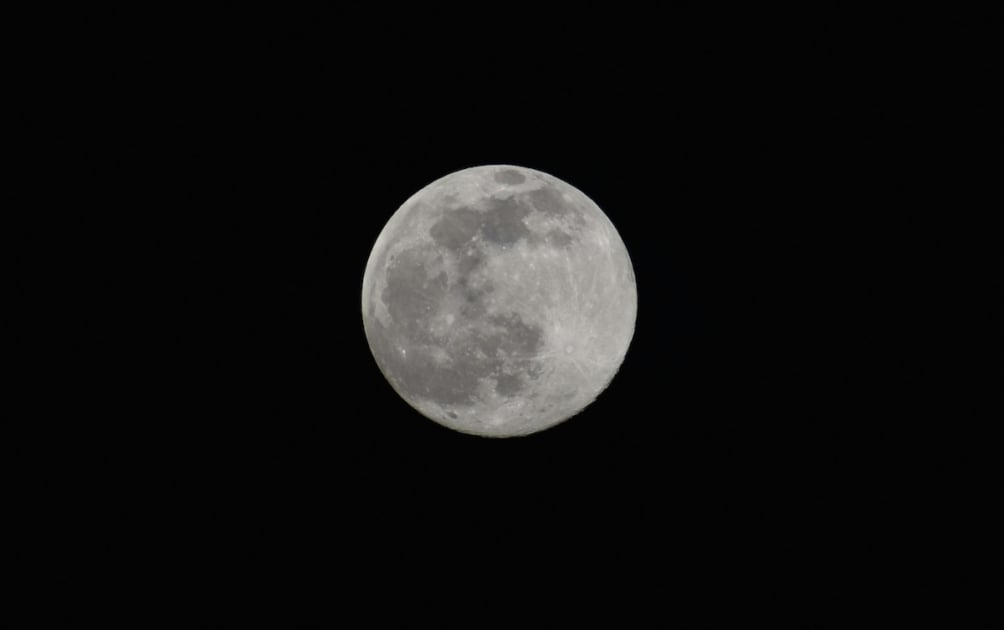
Quick Reference: Full Moons
- Next full Moon: Full Harvest Moon on September 26, 2026, at 12:49 p.m. EDT (named because it is the full Moon closest to the autumnal equinox, traditionally providing extra evening moonlight during the fall harvest).
- Next full Moon after that: Full Hunter’s Moon on October 26, 2026, at 12:12 a.m. EDT (traditionally named for the time of year when hunters prepared for the coming winter).
- Average lunar cycle: 29.5 days; the full Moon arrives roughly 15 days after the new Moon
- Times listed below: Eastern Standard or Eastern Daylight Time, depending on the date
- Total full Moons in 2026: 13 (because May has two)
Full Moon Calendar 2026: Next Full Moon, Dates, Times & Names
When is the next full Moon? The next full Moon is the Harvest Moon on Saturday, September 26, 2026, at 12:49 p.m. EDT.
Although the Moon reaches its exact full phase during the afternoon in the Eastern United States, it will look beautifully full when it rises that evening. It will also appear nearly full the night before and the night after.
Below you’ll find the complete 2026 full Moon calendar, including dates, times, traditional full Moon names, and the best nights to look up.
When Is the Next Full Moon?
The next full Moon occurs on:
Saturday, September 26, 2026
12:49 p.m. EDT
Full Harvest Moon
This is the Harvest Moon, the traditional name given to the full Moon that occurs closest to the autumnal equinox.
In 2026, the autumnal equinox arrives on September 22, making the September 26 full Moon this year’s Harvest Moon.
The Harvest Moon has long held special significance for farmers. Near the autumn equinox, the Moon rises only a little later on successive evenings, historically providing several nights of bright moonlight at a time when crops were being gathered.
The full Moon after the Harvest Moon will be the Hunter’s Moon, reaching peak illumination just after midnight Eastern Time on October 26.
2026 Full Moon Calendar
Here are all 13 full Moons in 2026, including their traditional names and peak times for the major U.S. time zones.
| Date | Full Moon Name | Eastern | Central | Mountain | Pacific |
|---|---|---|---|---|---|
| January 3 | Wolf Moon | 5:03 a.m. EST | 4:03 a.m. | 3:03 a.m. | 2:03 a.m. |
| February 1 | Snow Moon | 5:09 p.m. EST | 4:09 p.m. | 3:09 p.m. | 2:09 p.m. |
| March 3 | Worm Moon | 6:38 a.m. EST | 5:38 a.m. | 4:38 a.m. | 3:38 a.m. |
| April 1 | Pink Moon | 10:12 p.m. EDT | 9:12 p.m. | 8:12 p.m. | 7:12 p.m. |
| May 1 | Flower Moon | 1:23 p.m. EDT | 12:23 p.m. | 11:23 a.m. | 10:23 a.m. |
| May 31 | Blue Moon | 4:45 a.m. EDT | 3:45 a.m. | 2:45 a.m. | 1:45 a.m. |
| June 29 | Strawberry Moon | 7:57 p.m. EDT | 6:57 p.m. | 5:57 p.m. | 4:57 p.m. |
| July 29 | Buck Moon | 10:36 a.m. EDT | 9:36 a.m. | 8:36 a.m. | 7:36 a.m. |
| August 28 | Sturgeon Moon | 12:18 a.m. EDT | 11:18 p.m.* | 10:18 p.m.* | 9:18 p.m.* |
| September 26 | Harvest Moon | 12:49 p.m. EDT | 11:49 a.m. | 10:49 a.m. | 9:49 a.m. |
| October 26 | Hunter’s Moon | 12:12 a.m. EDT | 11:12 p.m.* | 10:12 p.m.* | 9:12 p.m.* |
| November 24 | Beaver Moon | 9:53 a.m. EST | 8:53 a.m. | 7:53 a.m. | 6:53 a.m. |
| December 23 | Cold Moon | 8:28 p.m. EST | 7:28 p.m. | 6:28 p.m. | 5:28 p.m. |
*Falls on the previous calendar date in that time zone.
How Many Full Moons Are There in 2026?
There are 13 full Moons in 2026, rather than the usual 12.
That’s because May contains two full Moons: the Flower Moon on May 1 and another full Moon on May 31.
The second full Moon in a calendar month is commonly known as a Blue Moon.
Full Moon Names for 2026
The familiar names attached to full Moons are tied to the seasons and the natural world.
The names used today by American almanacs come from a mixture of Indigenous North American traditions, colonial American customs, and European traditions. Exact names varied considerably from one nation, region, and historical period to another, which is why you may occasionally see different names used for the same month’s full Moon.
Here are the names most commonly used today.
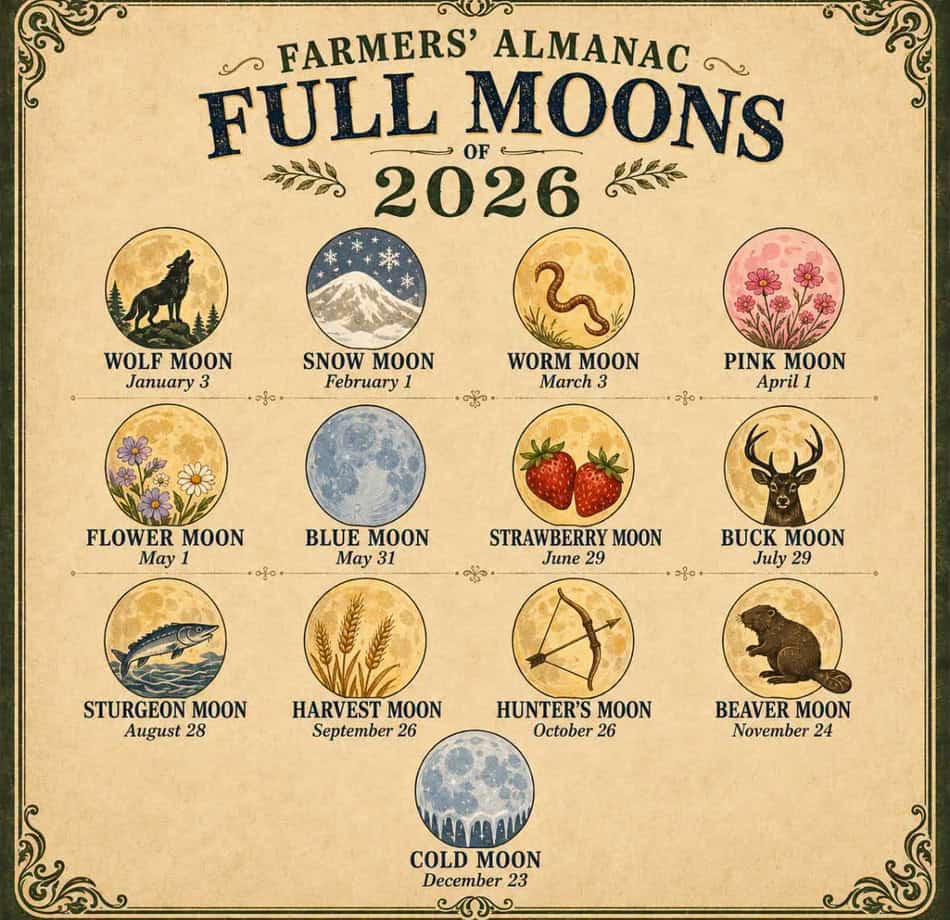
January: Wolf Moon
January’s full Moon is traditionally called the Wolf Moon, evoking the long, cold nights of midwinter when wolves were often heard howling.
Other traditional names include the Old Moon and Moon After Yule.
February: Snow Moon
The Snow Moon takes its name from the heavy snow that traditionally blankets much of northern North America during February.
It has also been called the Hunger Moon and Storm Moon.
March: Worm Moon
The Worm Moon signals the approach of spring.
As temperatures begin to rise, frozen ground starts to soften and signs of life return to the soil. Other names associated with March include the Crow Moon, Sap Moon, and Lenten Moon.
April: Pink Moon
April’s Pink Moon isn’t actually pink.
The name is traditionally associated with the spring bloom of creeping phlox, a pink wildflower native to parts of eastern North America.
April’s full Moon is also sometimes called the Egg Moon, Fish Moon, or Sprouting Grass Moon.
May: Flower Moon
By May, spring flowers are blooming across much of the Northern Hemisphere, giving us the appropriately named Flower Moon.
May’s full Moon has also been called the Milk Moon, Hare Moon, and Corn Planting Moon.
And in 2026, May gets a bonus.
May 31: Blue Moon
May 2026 contains two full Moons.
The second, on May 31, qualifies as a Blue Moon under the modern calendar-month definition.
Despite the name, the Moon does not normally turn blue.
The expression “once in a blue Moon” arose because an extra full Moon is relatively uncommon.
June: Strawberry Moon
June’s Strawberry Moon traditionally marked the short strawberry-harvesting season in parts of North America.
Other names associated with the June full Moon include the Rose Moon, Honey Moon, and Mead Moon.
July: Buck Moon
The Buck Moon gets its name from the period when male deer begin growing new antlers.
These antlers emerge covered in soft velvet and continue developing throughout summer.
July’s full Moon is also known as the Thunder Moon or Hay Moon.
August: Sturgeon Moon
The Sturgeon Moon is traditionally associated with the season when large sturgeon were more readily caught in the Great Lakes and other waterways.
Other names include the Grain Moon, Green Corn Moon, and Red Moon.
September: Harvest Moon
September 26 brings one of the best-known full Moons of the year: the Harvest Moon.
Unlike most traditional Moon names, the Harvest Moon is determined by the equinox rather than being permanently assigned to September.
It is simply the full Moon closest to the autumnal equinox.
Most years that occurs in September, but occasionally the Harvest Moon falls in October.
For generations of farmers, the Harvest Moon was especially useful because its bright light and relatively early evening moonrises helped extend the working day during harvest season.
October: Hunter’s Moon
The first full Moon following the Harvest Moon is traditionally known as the Hunter’s Moon.
Historically, harvested fields and bright autumn moonlight made animals easier to spot as communities prepared for winter.
Other names include the Travel Moon and Dying Grass Moon.
November: Beaver Moon
November’s Beaver Moon is associated with the time of year when beavers prepare intensively for winter and waterways across colder regions begin to freeze.
It has also been called the Frost Moon.
December: Cold Moon
December brings the Cold Moon, an appropriate name for a full Moon arriving near the beginning of winter.
Because December nights are among the longest of the year in the Northern Hemisphere, this full Moon can remain above the horizon for a particularly long stretch of the night.
It is also known as the Long Nights Moon.
What Is a Full Moon?
A full Moon occurs when the Moon is positioned opposite the Sun as seen from Earth.
Sunlight illuminates the half of the Moon facing Earth, causing the lunar disk to appear round and bright.
The exact moment of the full Moon is an astronomical instant rather than an entire night. That’s why full Moon calendars include a precise time.
To our eyes, however, the Moon can look full for a night or two on either side of that moment.
How Often Does a Full Moon Happen?
A full Moon occurs roughly once every 29.5 days.
That period is called a synodic month—the time it takes the Moon to move through one complete cycle of phases as seen from Earth.
Because our calendar months contain 28 to 31 days, the lunar cycle doesn’t line up perfectly with the calendar.
That’s why most months contain one full Moon, while occasionally a month contains two.
What Time Does the Full Moon Rise?
A full Moon generally rises near sunset and sets near sunrise.
The exact moonrise time depends on your location and the date.
One of the best times to photograph a full Moon is shortly after moonrise. When the Moon is close to the horizon, buildings, mountains, barns, trees, and other familiar objects can provide scale and create dramatic photographs.
Atmospheric effects near the horizon can also make the rising Moon appear orange, gold, or even reddish.
Why Does the Moon Look So Big Near the Horizon?
You’ve probably seen a full Moon rising and thought it looked enormous.
Usually, the Moon hasn’t suddenly moved dramatically closer to Earth.
The effect is largely due to the Moon illusion, a visual phenomenon that makes the Moon appear larger near the horizon than when it is high overhead.
Putting the Moon next to trees, buildings, mountains, and other familiar objects gives your brain reference points that exaggerate its apparent size.
What Is a Supermoon?
A supermoon is a popular term for a full Moon occurring when the Moon is relatively close to Earth in its elliptical orbit.
The Moon’s closest orbital point is called perigee.
A full Moon near perigee can appear somewhat larger and brighter than a full Moon occurring near the Moon’s farthest point from Earth.
The difference is often subtle to the naked eye, but supermoons can be especially striking when seen rising near the horizon.
What Is a Blue Moon?
There are two commonly used definitions.
Under the modern definition, a Blue Moon is the second full Moon occurring within one calendar month.
Under an older seasonal definition, a Blue Moon is the third full Moon in a season containing four full Moons instead of the usual three.
The May 31, 2026 full Moon is a Blue Moon under the modern monthly definition.
And no—the Moon normally doesn’t actually look blue.
Does a Full Moon Cause Higher Tides?
The Moon’s gravity plays a major role in Earth’s tides.
Around both the full Moon and new Moon, the gravitational effects of the Sun and Moon reinforce one another, producing larger differences between high and low tide. These are known as spring tides.
“Spring” in this case refers to the idea of water springing or rising—it has nothing to do with the season.
Coastal conditions, wind, weather, geography, and ocean currents also influence the height and timing of local tides.
Can a Full Moon Affect Sleep or Behavior?
People have associated full Moons with strange behavior, sleeplessness, and unusual events for centuries.
That’s where words such as lunatic and countless pieces of Moon folklore originated.
Scientific research, however, has not established a consistent connection between full Moons and dramatic changes in human behavior.
The Moon certainly affects Earth physically—most notably through tides—but many popular claims about full Moons and human behavior remain folklore rather than established science.
Full Moon Viewing Tips
You don’t need a telescope to enjoy a full Moon.
Simply find a location with a clear view of the eastern horizon around sunset.
For the most dramatic view:
- Check your local moonrise time.
- Arrive 15 to 30 minutes early.
- Look toward the eastern horizon.
- Choose a location with an open view.
- Use trees, barns, mountains, skylines, or other foreground objects for photographs.
- Bring binoculars if you’d like a closer look.
Interestingly, the exact full Moon isn’t always the best time to see lunar craters through a telescope. When sunlight strikes the Moon almost straight on, shadows are short.
During the quarter and crescent phases, lower-angle sunlight produces longer shadows that can make mountains and crater walls stand out more dramatically.
What Are the Eight Phases of the Moon?
The Moon passes through eight commonly recognized phases during each lunar cycle:
- New Moon
- Waxing Crescent
- First Quarter
- Waxing Gibbous
- Full Moon
- Waning Gibbous
- Last Quarter
- Waning Crescent
Waxing means the illuminated portion we see is growing.
Waning means it is shrinking.
After roughly 29.5 days, the cycle begins again.
Frequently Asked Questions About the Full Moon
When is the next full Moon?
The next full Moon is the Harvest Moon on September 26, 2026, at 12:49 p.m. EDT.
What is the full Moon in September 2026?
The September 2026 full Moon is the Harvest Moon. It reaches peak illumination on September 26 at 12:49 p.m. EDT.
When is the Hunter’s Moon in 2026?
The Hunter’s Moon reaches its full phase on October 26, 2026, at 12:12 a.m. EDT.
Because that moment occurs just after midnight in the Eastern Time Zone, it falls on the evening of October 25 in Central, Mountain, Pacific, Alaska, and Hawaii time zones.
How many full Moons are there in 2026?
There are 13 full Moons in 2026.
May has two: May 1 and May 31.
When is the Blue Moon in 2026?
The 2026 Blue Moon occurs on May 31 at 4:45 a.m. EDT. It is the second full Moon of May.
Is the full Moon really full all night?
Not technically.
The Moon reaches its full phase at one precise astronomical moment. However, it can appear almost perfectly full for a night or two before and after that time.
Does the full Moon always rise at sunset?
A full Moon generally rises around sunset because it sits roughly opposite the Sun in the sky. The exact time varies according to your location and the Moon’s orbit.
Why are full Moons named?
People have used seasonal names for full Moons for generations as a way to mark changes in weather, plants, animals, farming, hunting, and other annual events.
The familiar names used today reflect several cultural traditions rather than one universal naming system.
Is a Harvest Moon always in September?
No.
The Harvest Moon is the full Moon closest to the autumnal equinox. It usually occurs in September but can occasionally occur in October.
Follow the Moon All Year
The full Moon may get most of the attention, but every phase offers something different to watch.
Use the Farmers’ Almanac Moon Phase Calendar to follow new Moons, quarter Moons, crescent Moons, full Moons, and other celestial events throughout the year.
And remember to look up.
For more than two centuries, Farmers’ Almanac readers have watched the skies, followed the seasons, and marked the rhythms of the natural world. The Moon remains one of the easiest—and most beautiful—ways to do it.
Frequently Asked Questions
When is the next full Moon?
The Flower Moon peaks on May 1, 2026 at 1:23 p.m. EDT. The next one after that is the Blue Moon on May 31, 2026 at 4:45 a.m. EDT, the second full Moon of May 2026. See the table above for every full Moon of 2026.
Why does the full Moon have a name like “Wolf” or “Worm”?
The names trace back to Native American tribes, especially Algonquian-speaking peoples of the Northeast, who tagged each month’s full Moon to the season’s natural events: wolves howling in January, worms surfacing as the ground thawed in March, sturgeon running in August. European settlers adopted the custom and almanacs have published the names since the 1930s.
What is a Blue Moon?
By the modern definition, a Blue Moon is the second full Moon in a calendar month. The original definition is the third full Moon in a season that has four. May 31, 2026 is the next Blue Moon by the monthly definition.
What is a supermoon?
A supermoon is a full or new Moon that occurs when the Moon is at least 90 percent of the way to perigee, its closest approach to Earth. It looks about 7 percent larger and 15 percent brighter than an average full Moon. 2025 ended with three in a row: October, November, and December.
How many full Moons are in a year?
Most years have 12 full Moons. Years with a Blue Moon, like 2026, have 13. The lunar cycle is 29.5 days, so over time the extra days add up to one extra full Moon roughly every 2.7 years.
Does the full Moon affect sleep?
Some studies have found small but real effects: people tend to fall asleep slightly later and sleep slightly less around the full Moon. The cause is debated. The brighter sky is one candidate, although the effect persists in light-controlled experiments.
Why are the times listed in Eastern Time?
The Farmers’ Almanac is headquartered in Lewiston, Maine, and our calendars list times in Eastern Standard Time, switching to Eastern Daylight Time during daylight saving. To convert: subtract 1 hour for Central, 2 for Mountain, 3 for Pacific, and 5 for Hawaii. The exact moment of full Moon is the same worldwide; only the local clock changes.
Join the Discussion!
Do you have a favorite name from our Full Moon Calendar here?
What are some things you do to celebrate the Moon?
Share your photos in the comments below!
September’s full Moon is the one most people know by name. Read the full guide to the Harvest Moon 2026, including why it rises so close to sunset for several nights running, and what that meant before tractors had headlights.
2026 Full Moon Calendar: Every Date, Time, and the Story Behind the Name
In 2026, there are 13 full moons — an extra moon squeezed into the calendar year because the 29.5-day lunar cycle runs slightly shorter than most calendar months. The 13th moon falls on May 31, making it a Blue Moon. All times below are Eastern Time (ET); subtract 1 hour for Central, 2 for Mountain, 3 for Pacific.
| Date | Time (ET) | Name | Also Known As | Story Behind the Name |
|---|---|---|---|---|
| January 3 | 5:03 AM | Wolf Moon | Old Moon, Moon After Yule, Ice Moon | Named for the howling of wolves that echoed through winter villages at night. When food was scarce and packs pressed close to settlements, the sound of wolves defined January nights across the northeastern woodlands. |
| February 1 | 5:09 PM | Snow Moon | Hunger Moon, Storm Moon, Bone Moon | February historically brought the heaviest snowfall across the Northeast and Great Lakes. “Hunger Moon” reflects how depleted winter food stores became by mid-February — the toughest month for both people and wildlife. |
| March 3 | 6:38 AM | Worm Moon | Crow Moon, Sap Moon, Lenten Moon, Sugar Moon | As March ground thaws, earthworms surface and robins return to feed — signs of spring’s first stirring. The Ojibwe called it the Sugar Moon, marking maple sugaring season. Note: a total lunar eclipse accompanies this full moon, visible from North America. |
| April 1 | 10:12 PM | Pink Moon | Sprouting Grass Moon, Egg Moon, Fish Moon, Paschal Moon | Named not for the color of the moon but for wild ground phlox (Phlox subulata), one of the first wildflowers of spring, which blooms in pink masses across eastern North America in April. When it falls near Easter, it becomes the Paschal Moon. |
| May 1 | 1:23 PM | Flower Moon | Corn Planting Moon, Milk Moon, Hare Moon | May’s explosion of blooms across the continent gave this moon its most common name. The Algonquian Corn Planting Moon marked the traditional safe time to plant after the last frost — a calendar built on lunar cycles rather than calendar dates. |
| May 31 | 4:45 AM | Blue Moon | Second full moon of May | A Blue Moon is the second full moon in a single calendar month, occurring roughly every two to three years. The phrase “once in a blue moon” entered the English language centuries before the modern definition was settled. In 2026, May is the month with two. |
| June 29 | 7:57 PM | Strawberry Moon | Rose Moon, Honey Moon, Mead Moon | The Algonquian name captured the short strawberry harvesting season of June. European settlers called it the Rose Moon for the roses in bloom. “Honey Moon” referred both to the warm honey-colored light this low moon casts near the horizon and to the tradition of mead-making from the honey harvest. |
| July 29 | 10:36 AM | Buck Moon | Thunder Moon, Hay Moon, Antler Moon | July is when white-tailed deer bucks begin growing their new antlers, visible as velvety nubs. “Thunder Moon” reflects July’s frequent afternoon thunderstorms across much of the continent — the month with the most lightning in the eastern US. |
| August 28 | 12:18 AM | Sturgeon Moon | Green Corn Moon, Grain Moon, Red Moon, Dispute Moon | Great Lakes and Lake Champlain tribes named this moon for the giant lake sturgeon, most easily speared from bark canoes in August when the fish ran in greatest numbers. The sturgeon, which can live 150 years and exceed 300 pounds, was a critical summer food source. |
| September 26 | 12:49 PM | Harvest Moon | Corn Moon, Barley Moon | The Harvest Moon is not always September’s full moon — it is whichever full moon falls closest to the autumn equinox, which can occasionally fall in October. In 2026, September 26 wins by weeks. Before electric light, farmers used its bright, low-angled light to work fields late into the evening during the critical harvest window. |
| October 26 | 12:12 AM | Hunter’s Moon | Travel Moon, Dying Grass Moon, Blood Moon, Sanguine Moon | After the Harvest Moon cleared the fields, hunters could spot deer and other game fattened on fallen grain against the bare, frostbitten landscape. The Hunter’s Moon rises at nearly the same time for several nights in a row — a quirk of orbital geometry that extends the bright hunting window. |
| November 24 | 9:53 AM | Beaver Moon | Frost Moon, Mourning Moon, Moon When the Rivers Begin to Freeze | November was the month to set beaver traps before rivers iced over, securing furs for the winter ahead. Beavers themselves are most active in November, working furiously to cache food under the ice before freeze-up seals their ponds. |
| December 23 | 8:28 PM | Cold Moon | Long Nights Moon, Oak Moon, Moon Before Yule, Frost Moon | December’s full moon rises during the longest nights of the year, hanging in the sky far longer than summer moons. “Long Nights Moon” is the most descriptive: December nights are 15 to 16 hours long across northern states, giving this moon ample time to dominate the winter sky. |
To find the full moon time in your time zone, use our 2026 Moon Phases Calendar, which lists every phase to the minute in Eastern, Central, Mountain, and Pacific time. For the best nights to plant by the moon, see our Gardening by the Moon Calendar.

My wife is epileptic and has oncet dementia, and has been getting chemo treatment as maintenance. I am beginning to recognize a pattern either a day before, on or 2 maybe 3 days after the full moon she will have a seizure and her sundowning occurs.
What is your theory on this?
I don know . . . What’s yours . . .
Thank you for this information. However I have been reading several other things and they are all stating that there are going to be 2 Full Moons in April of 2026. They will happen on April 1 and on April 30. Are yall not recognizing the second full moon for April 2026? Thanks! Have a great week everyone while enjoying this fall weather with leaves changing beautiful colors and falling onto the ground…make the ground colorful and arrange the leafs into a design! Let’s make our ground beneath us as beautiful as our sky is without being told to pick up trash and recycle and etc! Much love from Western Ky!
Hi Tala, Our 2026 Full Moon Calendar is correct; April 2026 will only have one full Moon, but May 2026 will have two full Moons. Please feel free to share with us links to the resources you are seeing online via this form: https://www.farmersalmanac.com/contact/general-comments-questions-feedback. We appreciate your question, and hope that you enjoy autumn in beautiful Kentucky!
When is the “Hunters’ Moon” for 2025?
Hi Dave, The full Moon tonight (October 6, 2025) is the Harvest Moon and also the Hunter’s Moon. Are you a hunter, or what makes you curious about the name? Let us know so that we can share more information with you. Thanks for your question!
I read in another reference if Beaver Moon is disappear due to Full Moon after Harvest Moon should be Hunter’s Moon. Would you like to elaborate it?
what is the meaning of a corn moon and what is a corn moon
Hi Melanie, Many American Indian tribes named the September full Moon in honor of the corn harvest. The Abenaki of the Northeast United States refer to September’s Moon as the “Corn Maker Moon.” The Pueblo and Zuni of the Southwest call it “Moon When the Corn is Taken In” and “Corn is Harvested Moon,” respectively. Please let us know if you have any other questions!
Corn Moon often interchangeable with Harvest Moon when fall in September, but sometimes Harvest Moon fall in October, also Hunter’s Moon. By definition, Beaver Moon still exist. How about some references mention if Hunter’s Moon should fall after Harvest Moon, thus if Corn Moon split up into Harvest Moon, Beaver Moon disappear?
My shot of tonight’s Flower Moon from Lewisville, Tx…
This is a stunning picture, Karl! You’re a great photographer. Thanks for sharing with us.
October 17, 2024 Hunter’s Moon from Louisiana
I need help. Is anyone awake right now? I’m going through a very strange time. I need a kind, and nice, and calm human to help me. I believe that I am Instinctually synchronising with the moon.
It is 6:24 am, and I have to stop. 🛑
Just need to know is the moon right now a new moon? 🌑
October 2 was the Hunter’s New Moon. We hope you are able to find sleep.
I love you
No
I’m sorry if I had seen this i would have helped you! I just want to give you major major props for reaching out for someone! I wish I had that strength as I’m sure many of us wish. I can’t imagine what or how your life was a year ago and im sure you never thought your comment would give others strength but Thank you for this! I wish you all the best! Much love from Western Ky!
Yes, I am a nurse and can attest to the full moon effects on our health and behaviors. I’m sure my nursing colleagues out there will agree with me. 🌝
Hi Pt. Pleasant Beach N.J. September 13, 2024 at 7:30 A.M. Sun rising through the clouds and to the right ? Interesting
I do love full moons , even though I find I get very restless. Can’t sleep .sometimes I can get moody depending on the phase of the moon